What Analog Outboard Gear Actually Does to Your Record
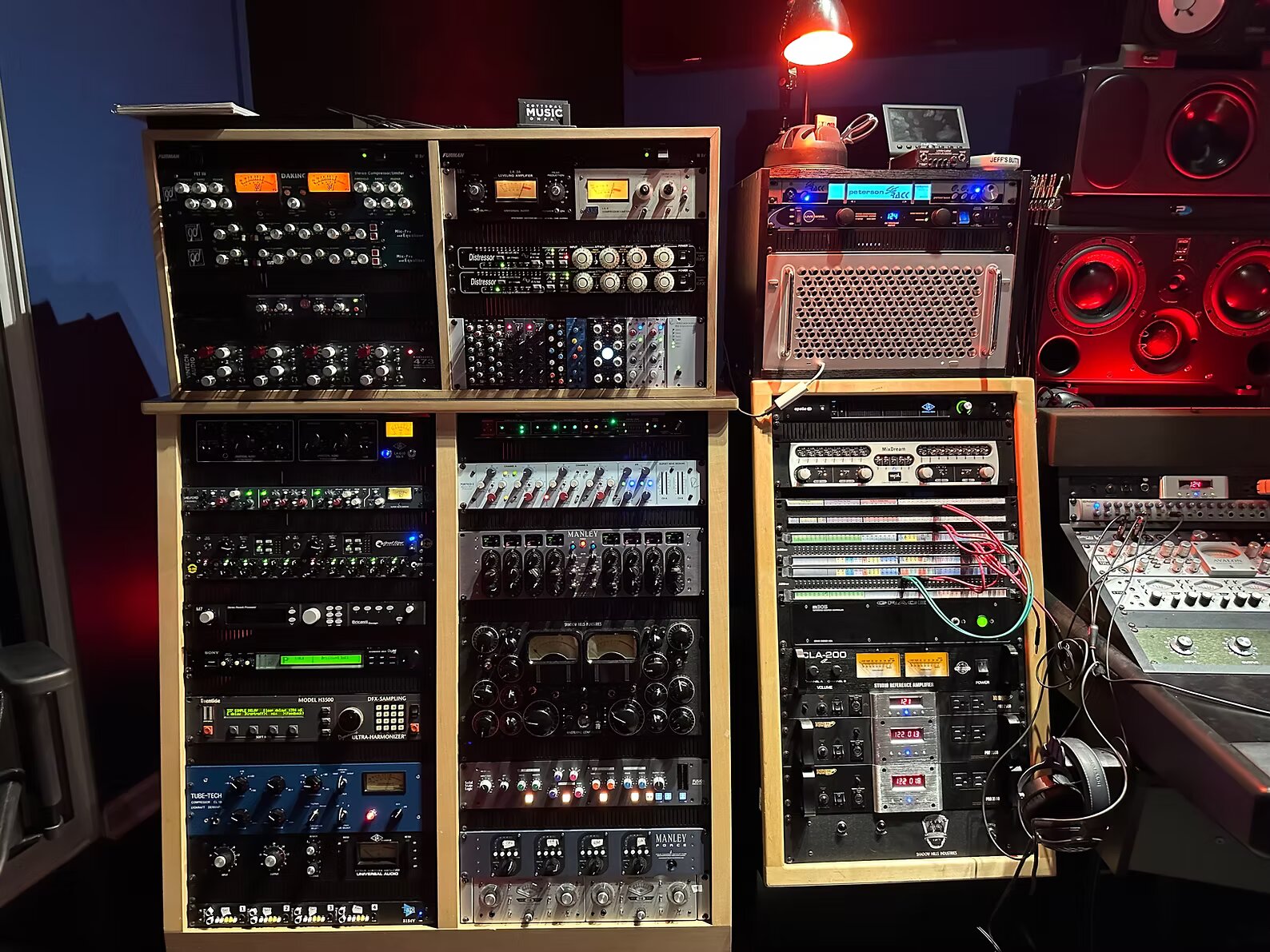
Walk into our control room and the first thing you see is the racks — rows of analog preamps, compressors, and EQs glowing amber. Clients ask the fair question: with plugins this good, what is all that actually for? Here's the unromantic answer.
Where analog genuinely differs
Analog circuits misbehave musically. Transformers and tubes add harmonics that get denser the harder you push them, and that nonlinearity responds to the performance in real time — louder phrases saturate more, which reads as excitement rather than distortion. Committing that character on the way in also changes how people work: you make a decision, it's on the recording, and the mix starts eighty percent finished instead of as four hundred undecided options.
Where plugins honestly win
Recall, automation, and surgical work. A plugin remembers every setting forever; a hardware unit needs photos and patience. Modern emulations are close enough that nobody's picking them out blindfolded on a single track. The gap shows up in accumulation — a whole record tracked through real iron has a density that's hard to fake twenty plugin instances at a time.
The hybrid chain we run
Our sessions track through analog — mic into hardware preamp and compressor, committed — then mix in the box where recall and automation live, often re-running key elements back through the racks when the record calls for it. Analog where it's felt, digital where it's fast. You can see the full rack list on our equipment page.
What it means for your project
None of this gear matters without the ears driving it — but when a vocal lands with that pushed, expensive thickness on the first playback, that's the racks doing what they do. Hear it on your own voice: come take the tour.
MAKE IT AT IMPERIAL
Reading only gets a record so far. Sessions from $90/hr with an engineer included — Tempe, AZ.